


| Author(s) / Composer(s) Erik Satie | |
| Contributeur(s) Revised by: Patrice Bourgès / Sarah Fahy | |
| Language(s) |
French |
|---|---|
| Collection | |
| Publisher |
Editions Bourgès R. |
| ISBN/ISMN |
9790560150444 |
| Instrumentation |
Piano Solo |
| Binding |
Stapled |
| Delivery method |
Digital format 1, Digital format 2, Digital format 3, Paper format |
| Publication date |
2010 |
| Weight (grams) |
100 |
| Format |
22,5 x 32 |
| Number of pages |
10 |
| Reference |
E196 |
Erik Satie
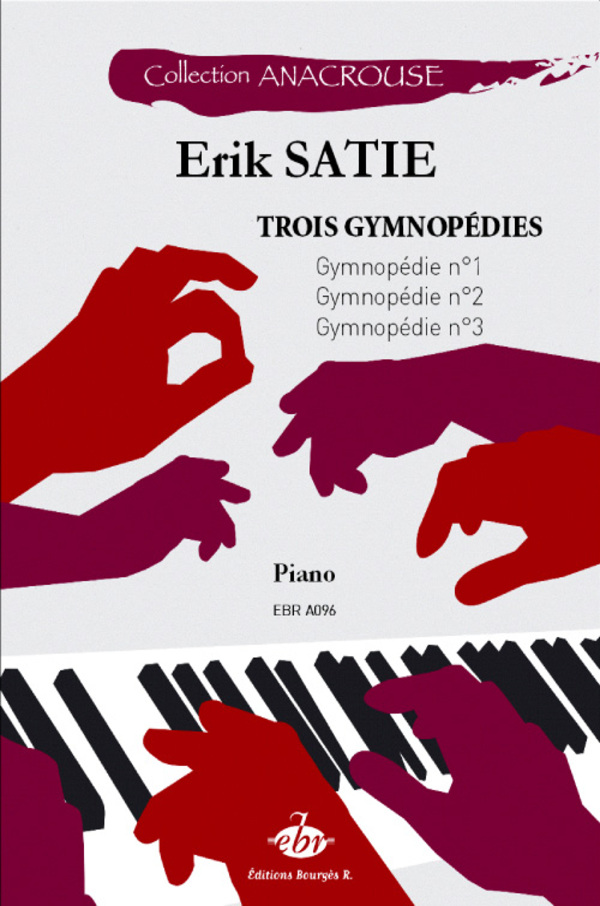
Three GymnopédiesThe Anacrouse collection offers pianists, beginners and advanced alike, a wide choice of classical works from the Renaissance to the present day. It brings together major works of the repertoire as well as rarer pieces, and also offers transcriptions for piano solo or four hands, selected for their musical and educational interest. Each score, available individually, benefits from careful editorial work: a rigorously established musical text, clear and legible engraving, accompanied by a short biography of the composer and a note on the work.
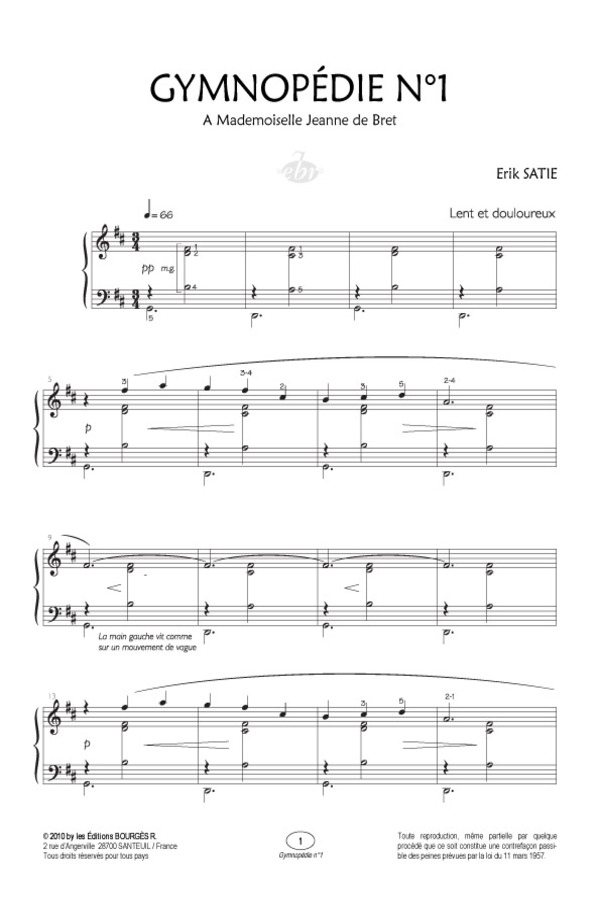
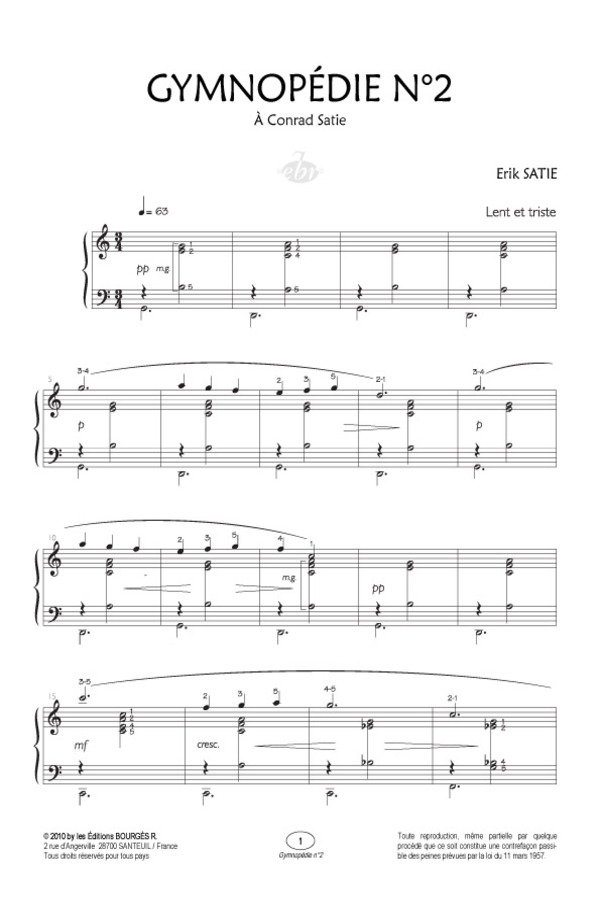
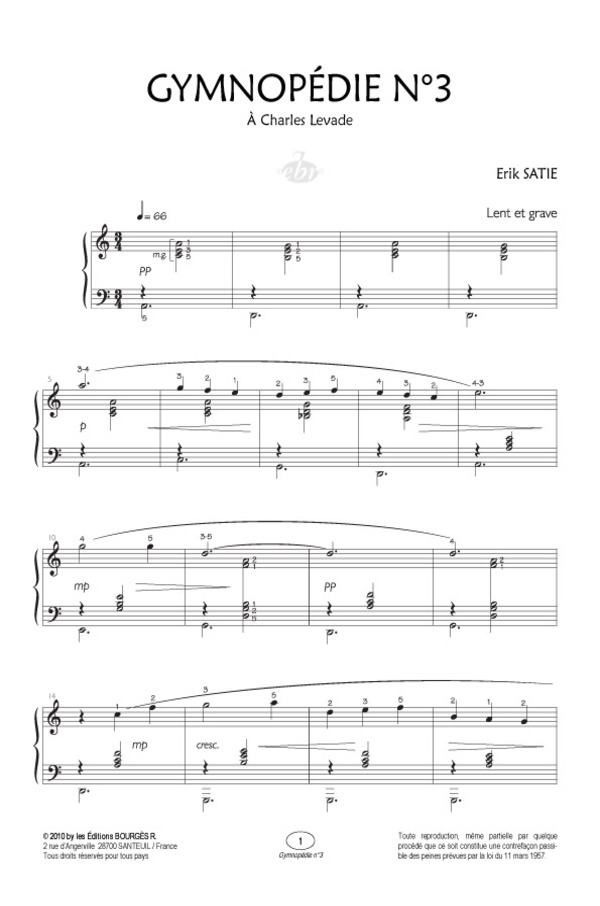
The “Trois Gymnopédies” have here undergone in-depth revision by Patrice Bourgès and Sarah Fahy, which sets this edition apart from standard versions through meticulous attention to comfort of performance. Where many editions saturate or neglect the markings, this work offers ergonomic fingerings designed to ease the wide left-hand leaps without breaking the legato. The dynamics have been finely adjusted to guide the performer in handling the ethereal sonority specific to Satie, while the modern engraving and the choice of highly legible typefaces offer optimal visual clarity. For the pianist, this editorial care frees the mind from the constraints of reading so as to concentrate exclusively on the shaping of the melody and mastery of the pedal, thus avoiding any harmonic blurring.
Composed in 1888 by Erik Satie (1866-1925), the Gymnopédies are masterpieces of “flat”, repetitive music. While their apparent simplicity appeals to pianists of all levels, their correct interpretation demands a rigour that this edition supports through its typographic choices and technical advice. Drawing on the original manuscripts while modernising the presentation, Patrice Bourgès and Sarah Fahy offer a reference version that combines historical respect with contemporary pedagogical requirements. These pieces, now pillars of French modernity, here recover a youthfulness and legibility that make this edition an indispensable tool for study and concert alike.
Gymnopédie No. 1
Gymnopédie No. 2
Gymnopédie No. 3