


| Author(s) / Composer(s) Wolfgang Amadeus Mozart | |
| Language(s) |
French |
|---|---|
| Collection | |
| Publisher |
Editions Bourgès R. |
| Reference |
EBRA019 |
| ISBN/ISMN |
9790560150918 |
| Instrumentation |
Piano Solo |
| Binding |
Stapled |
| Delivery method |
Digital format, Paper format |
| Publication date |
2006 |
| Weight (grams) |
100 |
| Format |
22,5 x 32 |
| Number of pages |
4 |
| Reference |
E119 |
Wolfgang Amadeus Mozart
Sonata K. 545The Anacrouse collection offers pianists, beginners and advanced alike, a wide choice of classical works from the Renaissance to the present day. It brings together major works of the repertoire as well as rarer pieces, and also offers transcriptions for piano solo or four hands, selected for their musical and educational interest. Each score, available individually, benefits from careful editorial work: a rigorously established musical text, clear and legible engraving, accompanied by a short biography of the composer and a note on the work.
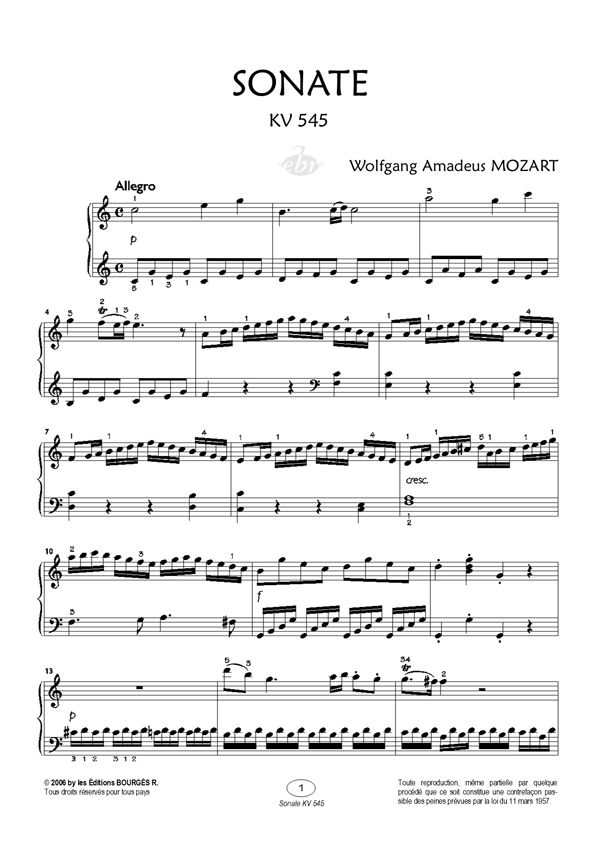
The “Allegro” of the “Sonata in C major, K. 545” is without doubt one of the most famous pages in the history of the piano. Although nicknamed the “easy” sonata (Sonata semplice) by Mozart himself, it is a considerable pedagogical challenge. For the pianist, it is the ideal tool for working on the limpidity of scales, the evenness of velocity runs and the mastery of Alberti basses in the left hand. It is a work that demands absolute precision and an elegance of touch characteristic of the galant style.
Composed in Vienna in 1788, this sonata is a model of formal perfection and thematic clarity. Paradoxically, Mozart never published it in his lifetime; it was only printed in 1805, several years after his death. Despite its apparent didactic dimension, this Allegro goes beyond mere exercise to become a demonstration of musical purity, in which every note must shine with the transparency of crystal.
Sonata K. 545 in C major - Allegro from Sonata No. 16, the so-called “easy” sonata