

| Author(s) / Composer(s) Debussy, Claude | |
| Language(s) |
French |
|---|---|
| Collection | |
| Publisher |
Editions Bourgès R. |
| Reference |
EBRA029 |
| ISBN/ISMN |
9790560150994 |
| Instrumentation |
Piano Solo |
| Binding |
Stapled |
| Delivery method |
Digital format, Paper format |
| Publication date |
2006 |
| Weight (grams) |
100 |
| Format |
22,5 x 32 |
| Number of pages |
6 |
| Reference |
E129 |
Debussy, Claude
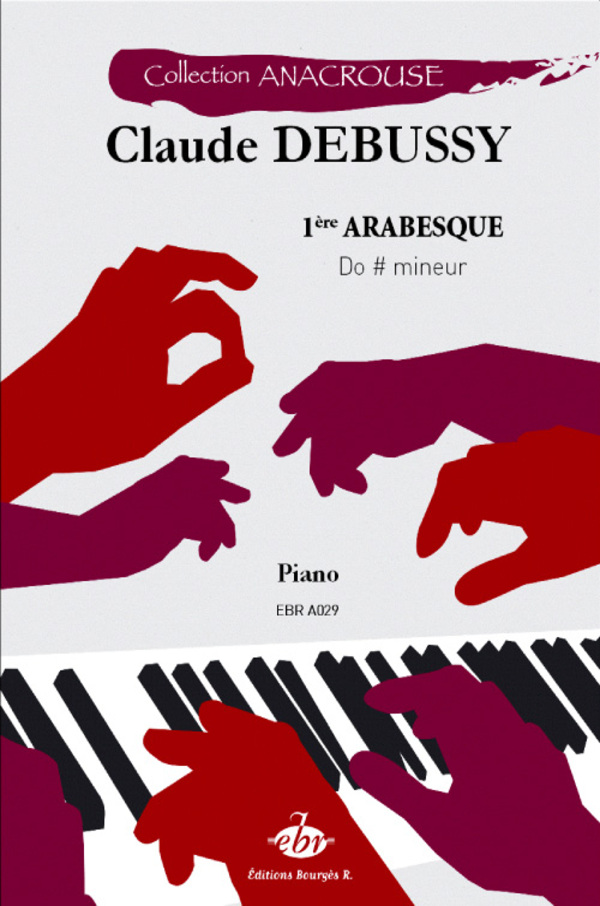
1st ArabesqueThe Anacrouse collection offers pianists, beginners and advanced alike, a wide choice of classical works from the Renaissance to the present day. It brings together major works of the repertoire as well as rarer pieces, and also offers transcriptions for piano solo or four hands, selected for their musical and educational interest. Each score, available individually, benefits from careful editorial work: a rigorously established musical text, clear and legible engraving, accompanied by a short biography of the composer and a note on the work.
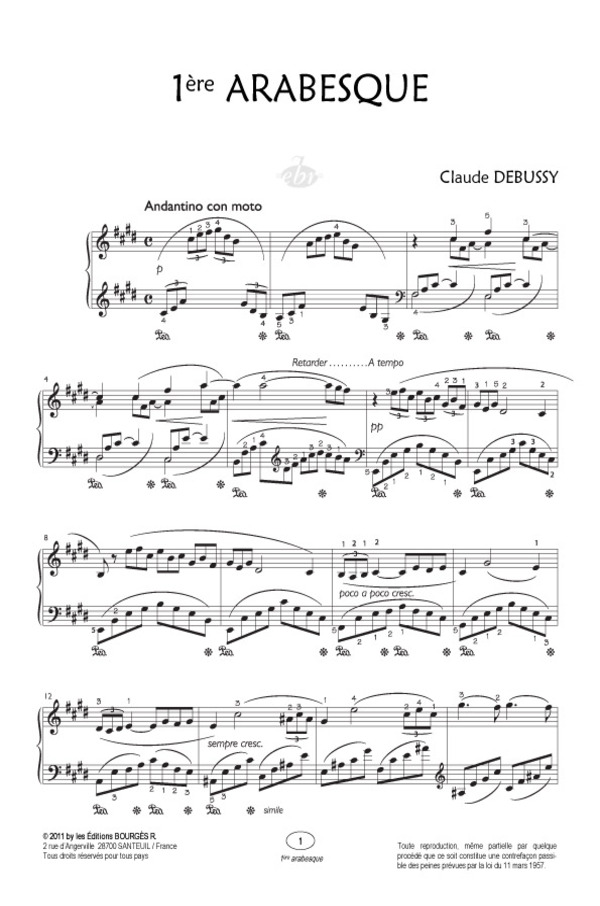
The “1st Arabesque” in E major is one of Claude Debussy’s most luminous early works. For the pianist, it is an essential study in polyrhythm, notably through its famous “two against three” passages (two quavers in the left hand against three triplet quavers in the right). The pedagogical challenge lies in the fluidity of the arpeggios, which must flow smoothly, and in the search for a transparent, fluid sonority evoking the curved lines of Art Nouveau.
Composed between 1888 and 1891, this piece is the first of the Deux Arabesques. At a time when French music was seeking a new path, Debussy invented a language founded on reverie and perpetual motion. The term “arabesque” here does not denote mere decoration, but a sinuous, organic musical line that frees itself from rigid structures to favour the pleasure of the ear and the poetry of the gesture.
1st Arabesque in E major