


| Author(s) / Composer(s) Ludwig van Beethoven | |
| Language(s) |
French |
|---|---|
| Collection | |
| Publisher |
Editions Bourgès R. |
| Reference |
EBRA032 |
| ISBN/ISMN |
9790560151014 |
| Instrumentation |
Piano Solo |
| Binding |
Stapled |
| Delivery method |
Digital format, Paper format |
| Publication date |
2006 |
| Weight (grams) |
100 |
| Format |
22,5 x 32 |
| Number of pages |
2 |
| Reference |
E132 |
Ludwig van Beethoven
Minuet WoO 10 No. 2The Anacrouse collection offers pianists, beginners and advanced alike, a wide choice of classical works from the Renaissance to the present day. It brings together major works of the repertoire as well as rarer pieces, and also offers transcriptions for piano solo or four hands, selected for their musical and educational interest. Each score, available individually, benefits from careful editorial work: a rigorously established musical text, clear and legible engraving, accompanied by a short biography of the composer and a note on the work.
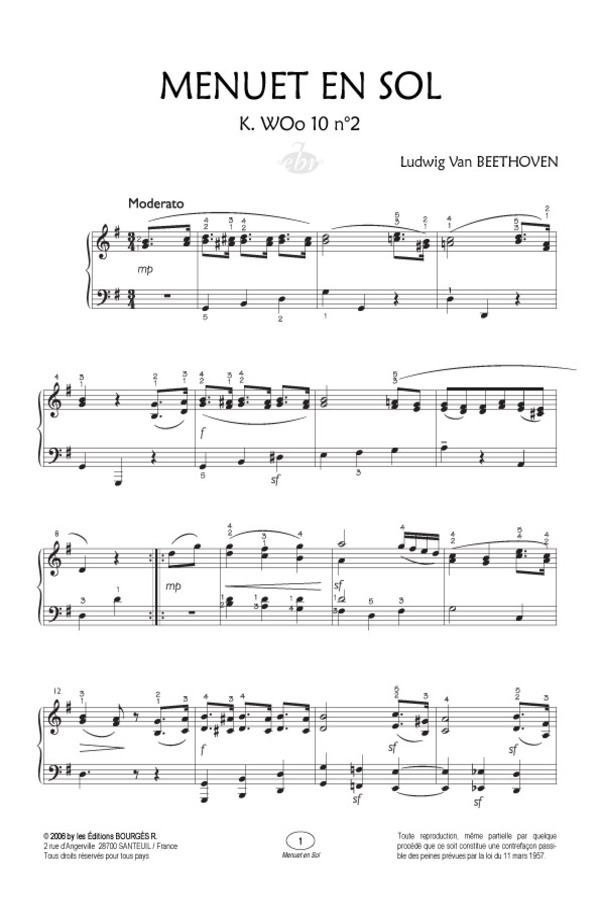
The “Minuet in G major, WoO 10 No. 2” is one of the most famous pages by the young Beethoven. From a pedagogical point of view, this piece is an ideal resource for working on the elegance of the classical style. The pianist can approach the mastery of right-hand octaves, the precision of ornaments (mordents and appoggiaturas) and the necessary contrast between the legato sections and the more martial passages. It is a rewarding work that requires fine handling of the rhythmic framework specific to the dance.
Originally composed for orchestra around 1795, this minuet is part of a set of six dances intended for the Redoute balls in Vienna. Its immediate success was such that it was quickly transcribed for piano, becoming a pillar of music teaching. Although Beethoven was then only at the start of his career, one can already perceive in this noble, rousing melody all the clarity and vigour that would characterise his later works.
Minuet WoO 10 No. 2 in G major