

| Author(s) / Composer(s) Johann Sebastian Bach | |
| Language(s) |
French |
|---|---|
| Collection | |
| Publisher |
Editions Bourgès R. |
| Reference |
EBRA037 |
| ISBN/ISMN |
9790560151083 |
| Instrumentation |
Piano Solo |
| Binding |
Stapled |
| Delivery method |
Digital format, Paper format |
| Publication date |
2006 |
| Weight (grams) |
100 |
| Format |
22,5 x 32 |
| Number of pages |
3 |
| Reference |
E137 |
Johann Sebastian Bach
4th Two-Part Invention BWV 775The Anacrouse collection offers pianists, beginners and advanced alike, a wide choice of classical works from the Renaissance to the present day. It brings together major works of the repertoire as well as rarer pieces, and also offers transcriptions for piano solo or four hands, selected for their musical and educational interest. Each score, available individually, benefits from careful editorial work: a rigorously established musical text, clear and legible engraving, accompanied by a short biography of the composer and a note on the work.
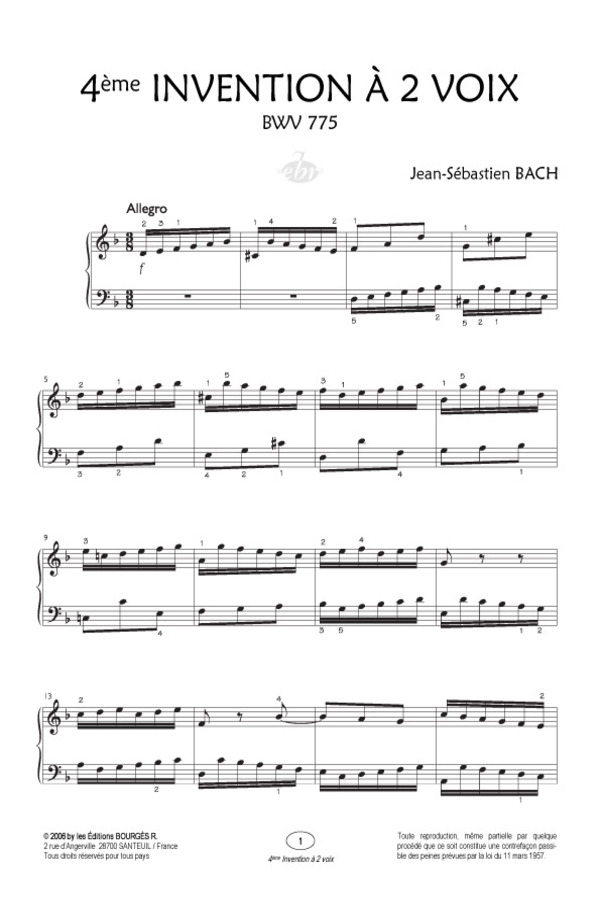
The “4th Two-Part Invention in D minor, BWV 775” is an essential step in the development of finger technique. For the pianist, it is a rigorous study in melodic minor scales and successions of triplets. The pedagogical challenge lies in perfect coordination between the two hands in the imitative passages, as well as in mastering the ornaments that punctuate the discourse. The playing must remain lively and incisive, requiring great clarity of articulation to bring out the dramatic, nervous character specific to the key of D minor.
Taken from the collection completed by Bach in 1723 in Köthen, this invention perfectly illustrates the concept of “developing a single motif”. From a simple subject rising by step, Bach weaves a tight dialogue of great harmonic inventiveness. Originally intended to train both the fingers and the musical mind of students, this piece remains a model of contrapuntal construction in which mathematical rigour never sacrifices the elegance of movement.
4th Two-Part Invention BWV 775 in D minor