


| Author(s) / Composer(s) Félicien David | |
| Language(s) |
French |
|---|---|
| Collection | |
| Publisher |
Editions Bourgès R. |
| Reference |
EBRA049 |
| ISBN/ISMN |
9790560151229 |
| Instrumentation |
Piano Solo |
| Binding |
Stapled |
| Delivery method |
Digital format, Paper format |
| Publication date |
2006 |
| Weight (grams) |
100 |
| Format |
22,5 x 32 |
| Number of pages |
6 |
| Reference |
E149 |
Félicien David
RêverieThe Anacrouse collection offers pianists, beginners and advanced alike, a wide choice of classical works from the Renaissance to the present day. It brings together major works of the repertoire as well as rarer pieces, and also offers transcriptions for piano solo or four hands, selected for their musical and educational interest. Each score, available individually, benefits from careful editorial work: a rigorously established musical text, clear and legible engraving, accompanied by a short biography of the composer and a note on the work.
The piece “L’Almée” (in A minor) invites the pianist to explore Félicien David’s sound world through rhythms marked by surprising bass lines, characteristic of a style conveying the power of Oriental charms. The work consists in making a melody sing as the guiding thread of an inner narrative, calling for sensitivity to nuance and an atmosphere steeped in gentleness. Evoking the graceful dance of the singers and dancers of Egypt, this piece in the minor mode demands great rhythmic precision to render the hypnotic, captivating swaying of the Orient.
If the Anacrouse collection offers this work today, it is to recall the history of the Ménilmontant community and the path of Félicien David (1810-1876). Following the tragic end of this movement and the trials that struck its leaders, David found himself effectively banished from French public life. It was this context of political constraint that drove him, at only 23, to leave France for an initiatory expedition to the Orient. Taken from the collection “Brises d’Orient”, this piece is a true private diary in which the man mirrors his youth in the West with his forced discoveries in a distant land. Bringing these pages back to life means rehabilitating a major figure of Orientalism whose life was upended by the repression of a utopia.
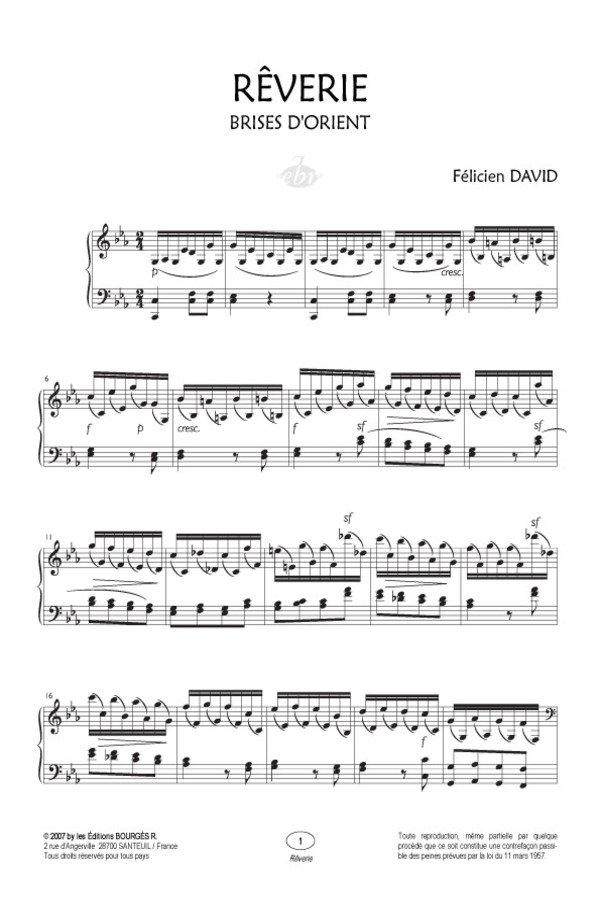
Rêverie in C minor - Brises d’Orient