


| Author(s) / Composer(s) Johannes Brahms | |
| Language(s) |
French |
|---|---|
| Collection | |
| Publisher |
Editions Bourgès R. |
| Reference |
EBRA054 |
| ISBN/ISMN |
9790560151335 |
| Instrumentation |
Piano Solo |
| Binding |
Stapled |
| Delivery method |
Digital format, Paper format |
| Publication date |
2007 |
| Weight (grams) |
100 |
| Format |
22,5 x 32 |
| Number of pages |
5 |
| Reference |
E154 |
Johannes Brahms
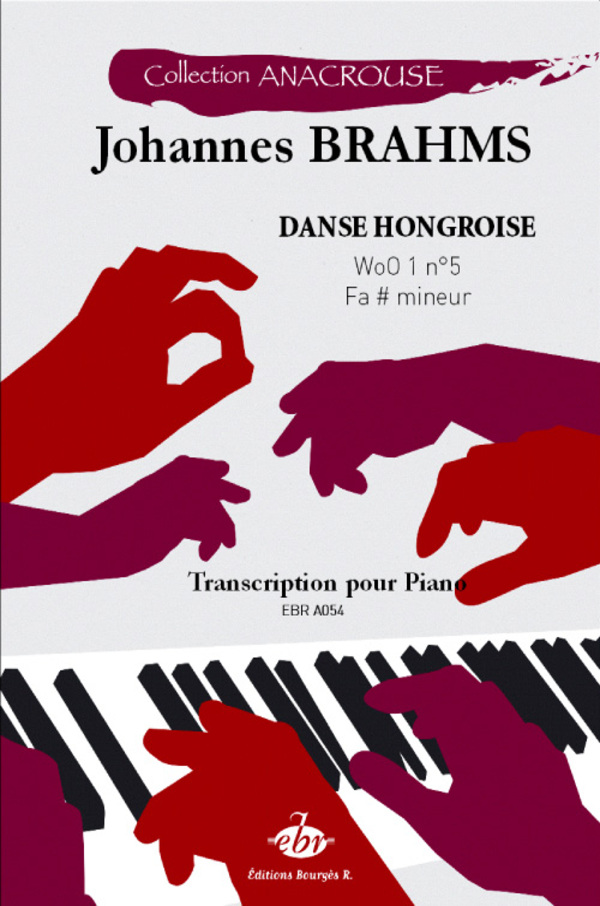
Hungarian Dance WoO 1 No. 5The Anacrouse collection offers pianists, beginners and advanced alike, a wide choice of classical works from the Renaissance to the present day. It brings together major works of the repertoire as well as rarer pieces, and also offers transcriptions for piano solo or four hands, selected for their musical and educational interest. Each score, available individually, benefits from careful editorial work: a rigorously established musical text, clear and legible engraving, accompanied by a short biography of the composer and a note on the work.
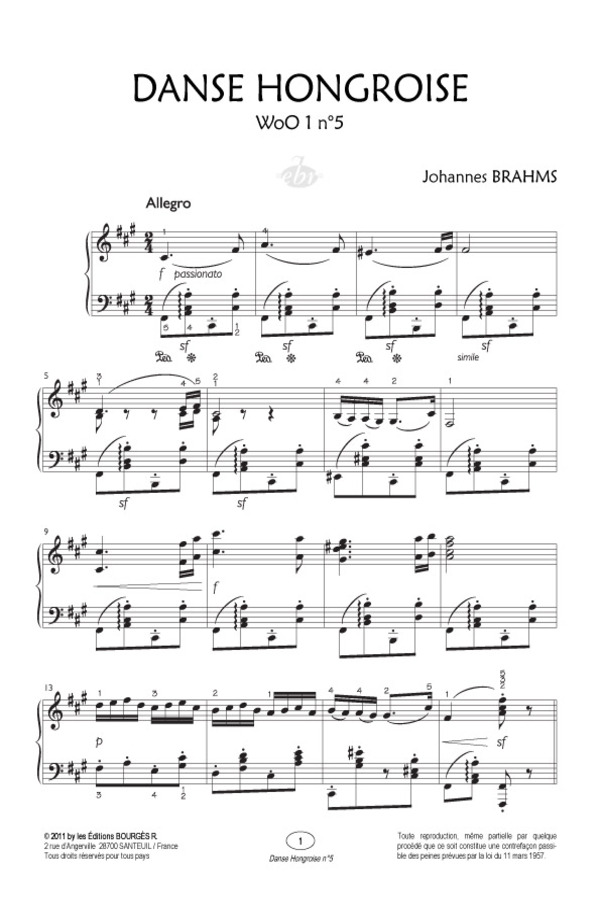
The “Hungarian Dance No. 5” (in F sharp minor) is a character piece that demands great mastery of dynamics and rhythm. The main challenge for the pianist lies in handling the sudden changes of tempo (rubato), moving from a fiery impetus to moments of melancholy restraint. The work focuses on the energy of the chords, the precision of the left-hand leaps and the clarity of the fast runs. It is an ideal exercise for developing expressive power and suppleness of playing, while absorbing the accents typical of the gypsy style.
Originally composed for piano four hands in 1869, this collection of twenty-one dances bears witness to the fascination of Johannes Brahms (1833-1897) for the popular music of Central Europe. No. 5 is based on the csárdás theme “Bártfai emlék” by the composer Béla Kéler, which Brahms believed to be an anonymous traditional tune. Although the composer did not seek to write a learned work, this dance conquered the whole world through its authenticity and vital force, becoming one of the emblems of the “Hungarian” musical soul as dreamed of by Romanticism.
Hungarian Dance WoO 1 No. 5 in F sharp minor