


| Author(s) / Composer(s) Wolfgang Amadeus Mozart | |
| Language(s) |
French |
|---|---|
| Collection | |
| Publisher |
Editions Bourgès R. |
| Reference |
EBRA063 |
| ISBN/ISMN |
9790560151465 |
| Instrumentation |
Piano Solo |
| Binding |
Stapled |
| Delivery method |
Digital format, Paper format |
| Publication date |
2007 |
| Weight (grams) |
100 |
| Format |
22,5 x 32 |
| Number of pages |
6 |
| Reference |
E163 |
Wolfgang Amadeus Mozart
Fantasia K. 397The Anacrouse collection offers pianists, beginners and advanced alike, a wide choice of classical works from the Renaissance to the present day. It brings together major works of the repertoire as well as rarer pieces, and also offers transcriptions for piano solo or four hands, selected for their musical and educational interest. Each score, available individually, benefits from careful editorial work: a rigorously established musical text, clear and legible engraving, accompanied by a short biography of the composer and a note on the work.
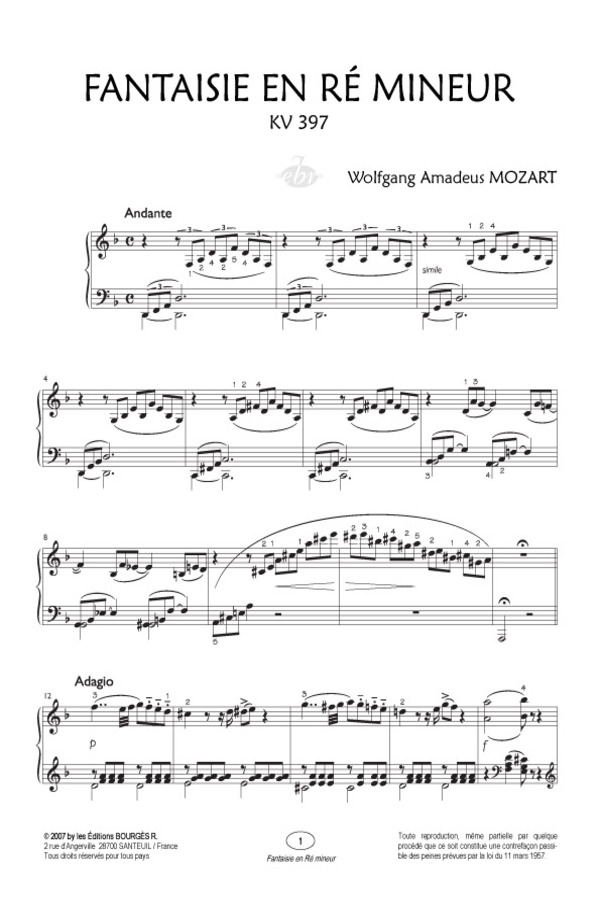
The “Fantasia in D minor” (K. 397) is a key piece for working on expressiveness and contrast. The pianist must navigate between mysterious arpeggiated preludes, a singing Adagio of great emotional depth and passages of improvised virtuosity (cadenzas). The challenge lies in handling the silences and changes of tone, as well as in the transition from the dark melancholy of D minor to the sudden brilliance of the D major finale. It is an excellent exercise for developing a sense of musical narrative and mastery of dynamics.
Composed in Vienna in 1782, this Fantasia is one of the most enigmatic pages by Mozart (1756-1791). It bears witness to his admiration for the style of Carl Philipp Emanuel Bach while asserting a surprising modernity. As an anecdote, Mozart left the work unfinished (stopping before the last bars of the major-key finale), and it was probably August Eberhard Müller who completed the score as we know it today. Despite its brevity, this work condenses the whole of Mozart’s duality: a poignant struggle between shadow and light.
Fantasia K. 397 in D minor