


| Author(s) / Composer(s) Claude Debussy | |
| Language(s) |
French |
|---|---|
| Collection | |
| Publisher |
Editions Bourgès R. |
| Reference |
EBRA069 |
| ISBN/ISMN |
9790560151519 |
| Instrumentation |
Piano Solo |
| Binding |
Stapled |
| Delivery method |
Digital format, Paper format |
| Publication date |
2007 |
| Weight (grams) |
100 |
| Format |
22,5 x 32 |
| Number of pages |
5 |
| Reference |
E169 |
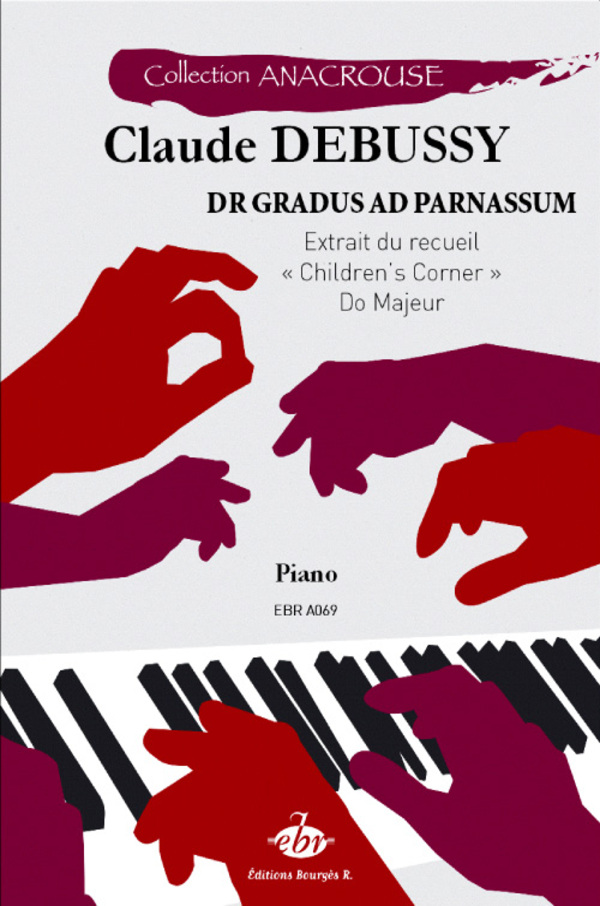
Claude Debussy
Dr Gradus ad ParnassumThe Anacrouse collection offers pianists, beginners and advanced alike, a wide choice of classical works from the Renaissance to the present day. It brings together major works of the repertoire as well as rarer pieces, and also offers transcriptions for piano solo or four hands, selected for their musical and educational interest. Each score, available individually, benefits from careful editorial work: a rigorously established musical text, clear and legible engraving, accompanied by a short biography of the composer and a note on the work.
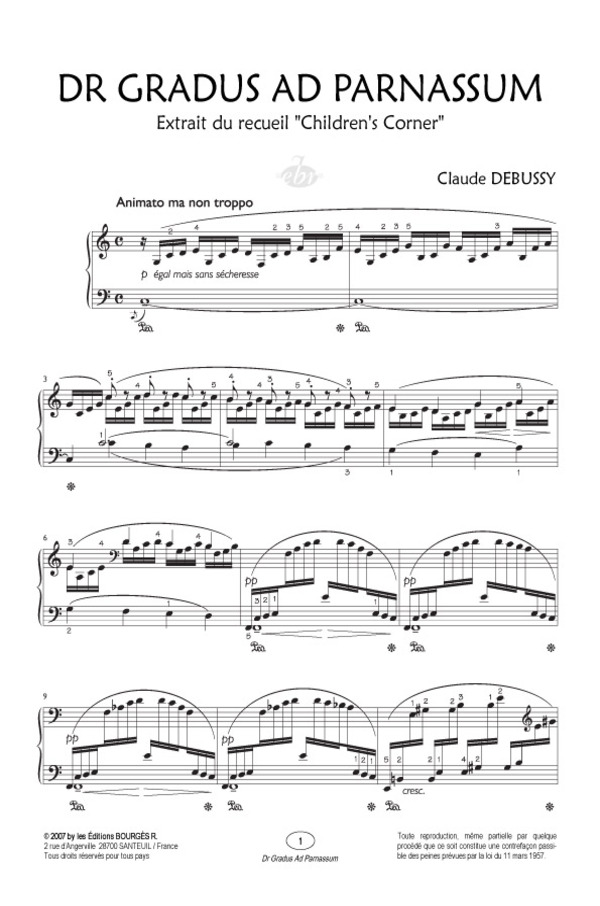
“Doctor Gradus ad Parnassum” (in C major) is a velocity study disguised as a genre scene. The technical challenge for the pianist lies in the evenness of the pearly touch and the fluidity of the semiquavers that run across the keyboard. But beyond the exercise, the aim is to convey Debussy’s irony: the piece begins with the rigour of a diligent pupil before escaping to dreamier, more agitated regions. The work focuses on wrist suppleness and subtle use of the pedal to colour the harmonies without ever blurring the clarity of the line.
Composed between 1906 and 1908 by Claude Debussy (1862-1918) for his daughter Chouchou, this piece opens the Children’s Corner suite. The title is an affectionate parody of Clementi’s famous collection of exercises, Gradus ad Parnassum (“The Ascent to Parnassus”). Debussy humorously depicts the boredom of a child at the piano, forced to repeat scales, before imagination takes over. Beneath its apparent simplicity, this piece marks the birth of a new piano style, blending classical precision and Impressionist modernity.
Dr Gradus ad Parnassum in C major