

| Author(s) / Composer(s) Johann Sebastian Bach | |
| Language(s) |
French |
|---|---|
| Collection | |
| Publisher |
Editions Bourgès R. |
| Reference |
EBRA076 |
| ISBN/ISMN |
9790560151588 |
| Instrumentation |
Piano Solo |
| Binding |
Stapled |
| Delivery method |
Digital format, Paper format |
| Publication date |
2007 |
| Weight (grams) |
100 |
| Format |
22,5 x 32 |
| Number of pages |
4 |
| Reference |
E176 |
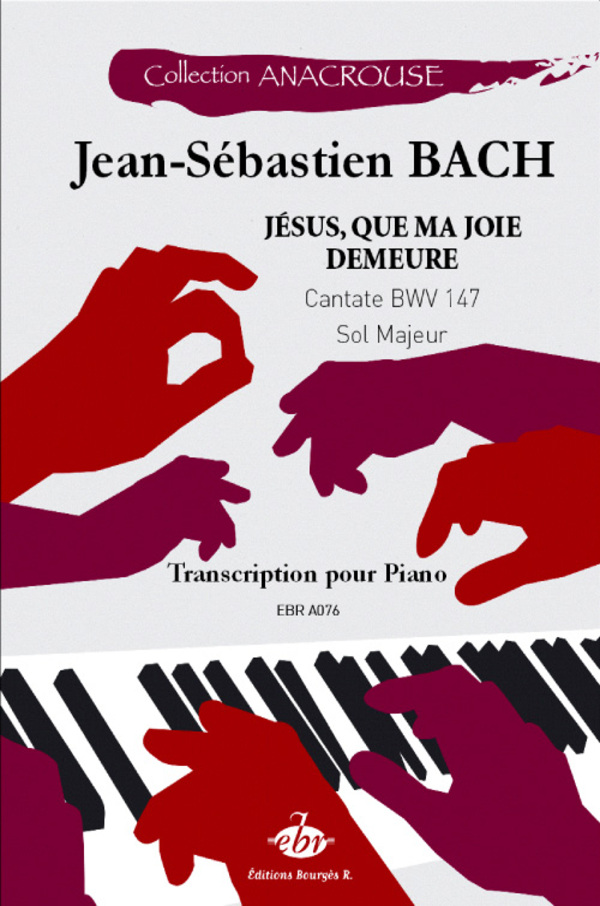
Johann Sebastian Bach
Jesu, Joy of Man’s Desiring, Cantata BWV 147The Anacrouse collection offers pianists, beginners and advanced alike, a wide choice of classical works from the Renaissance to the present day. It brings together major works of the repertoire as well as rarer pieces, and also offers transcriptions for piano solo or four hands, selected for their musical and educational interest. Each score, available individually, benefits from careful editorial work: a rigorously established musical text, clear and legible engraving, accompanied by a short biography of the composer and a note on the work.
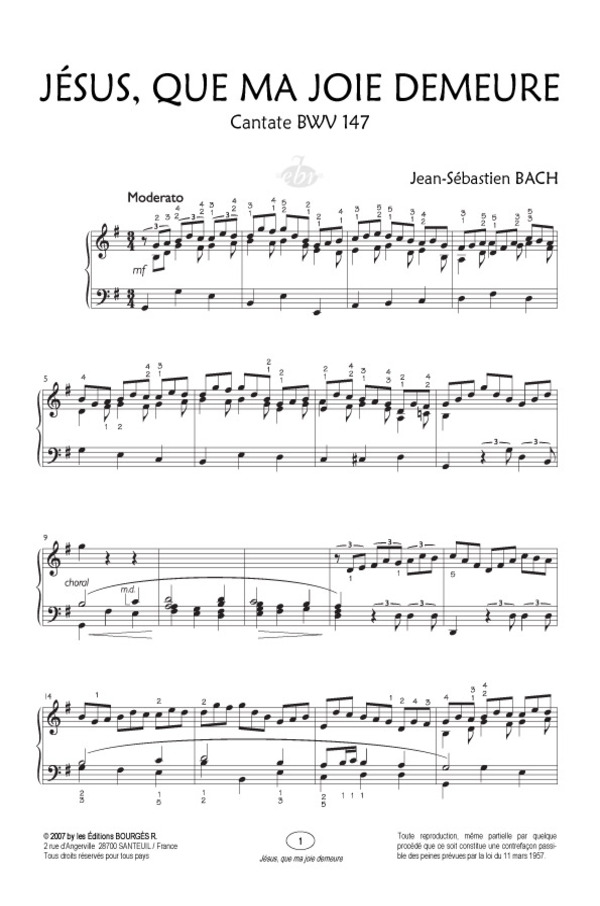
“Jesu, Joy of Man’s Desiring” (in G major) rests on the superimposition of two distinct sound planes. For the pianist, the challenge lies in the independence of the hands: the right hand must unroll an uninterrupted flow of triplets of perfect fluidity and evenness, while the chorale melody emerges above, noble and composed. The technical work focuses on legato, the shaping of the bass line and the search for a luminous, almost orchestral sonority, evoking both the strings and the oboe of the original version.
Composed by Johann Sebastian Bach (1685-1750) for his cantata Herz und Mund und Tat und Leben (BWV 147), this final chorale has become world-famous. Originally written for choir and orchestra, this movement illustrates the perfection of Bach’s writing, in which harmonic complexity melts into a melody of natural self-evidence. Popularised by the transcriptions of great pianists such as Myra Hess in the 20th century, this work is today a symbol of inner peace and one of the finest examples of the sacred dimension of Bach’s music.
Jesu, Joy of Man’s Desiring, Cantata BWV 147 in G major