

| Author(s) / Composer(s) Johann Sebastian Bach | |
| Language(s) |
French |
|---|---|
| Collection | |
| Publisher |
Editions Bourgès R. |
| Reference |
EBRA036 |
| ISBN/ISMN |
9790560151076 |
| Instrumentation |
Piano Solo |
| Binding |
Stapled |
| Delivery method |
Digital format, Paper format |
| Publication date |
2006 |
| Weight (grams) |
100 |
| Format |
22,5 x 32 |
| Number of pages |
2 |
| Reference |
E136 |
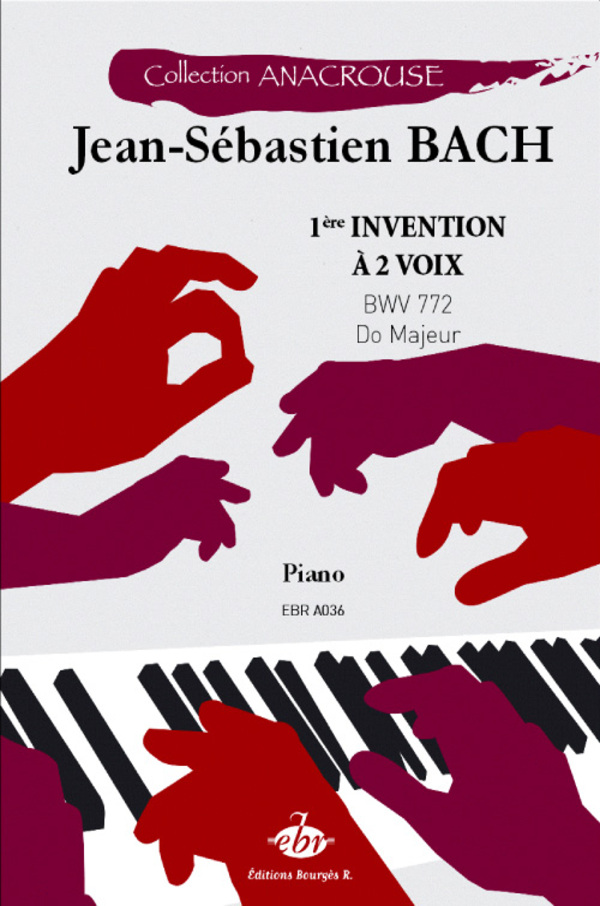
Johann Sebastian Bach
1st Two-Part Invention BWV 772The Anacrouse collection offers pianists, beginners and advanced alike, a wide choice of classical works from the Renaissance to the present day. It brings together major works of the repertoire as well as rarer pieces, and also offers transcriptions for piano solo or four hands, selected for their musical and educational interest. Each score, available individually, benefits from careful editorial work: a rigorously established musical text, clear and legible engraving, accompanied by a short biography of the composer and a note on the work.
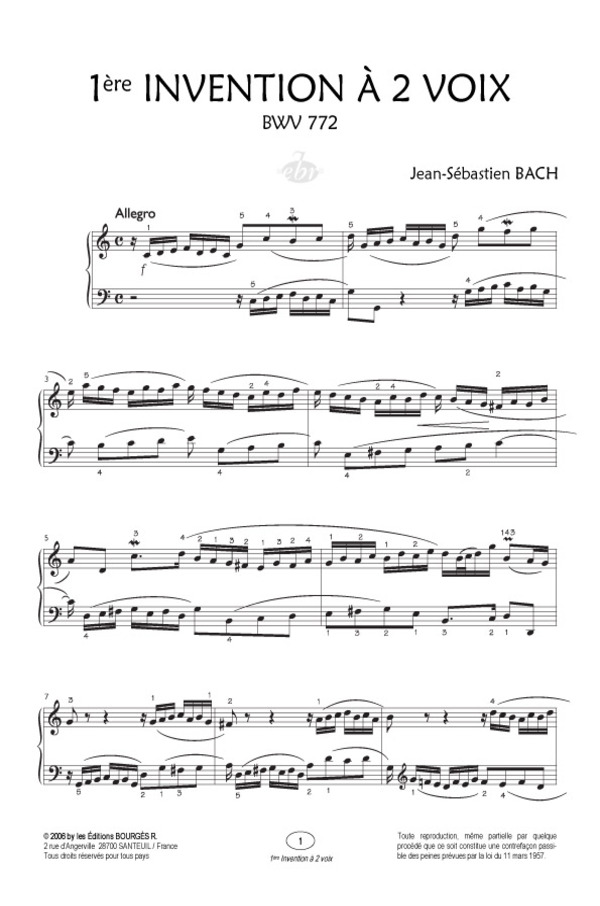
The “1st Two-Part Invention in C major, BWV 772” is the essential starting point for any pianist wishing to approach polyphonic music. From a pedagogical point of view, it is a masterly study in the independence of the hands: the theme, stated first in the right hand and then in the left, demands an even touch and absolute rhythmic precision. The work focuses on articulation (the non-legato or quasi-staccato playing typical of the Baroque era) and on the clarity of the dialogue between the two voices, which must be heard with equal importance.
Originally composed by Bach for the musical education of his eldest son Wilhelm Friedemann, the Inventions were intended to teach students not only to play cleanly in two voices, but also to develop a taste for composition and for “singing” at the keyboard. This first invention, with its limpid structure and its mirrored four-note motif, is a masterpiece of logic and clarity. Nearly three centuries later, it remains the indispensable foundation of piano technique and musical intelligence.
1st Two-Part Invention BWV 772 in C major