


| Author(s) / Composer(s) Johann Friedrich Franz Bürgmüller | |
| Language(s) |
French |
|---|---|
| Collection | |
| Publisher |
Editions Bourgès R. |
| Reference |
EBRA073 |
| ISBN/ISMN |
9790560151458 |
| Instrumentation |
Piano Solo |
| Binding |
Stapled |
| Delivery method |
Digital format, Paper format |
| Publication date |
2007 |
| Weight (grams) |
100 |
| Format |
22,5 x 32 |
| Number of pages |
3 |
| Reference |
E173 |
Johann Friedrich Franz Bürgmüller
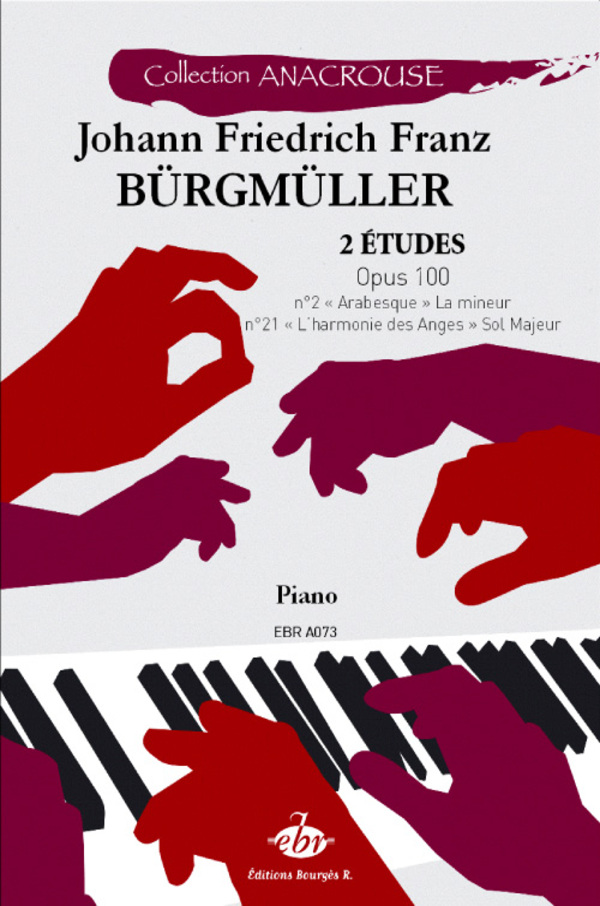
2 Études Opus 100: No. 2 “Arabesque” – No. 21 “Harmony of the Angels”The Anacrouse collection offers pianists, beginners and advanced alike, a wide choice of classical works from the Renaissance to the present day. It brings together major works of the repertoire as well as rarer pieces, and also offers transcriptions for piano solo or four hands, selected for their musical and educational interest. Each score, available individually, benefits from careful editorial work: a rigorously established musical text, clear and legible engraving, accompanied by a short biography of the composer and a note on the work.
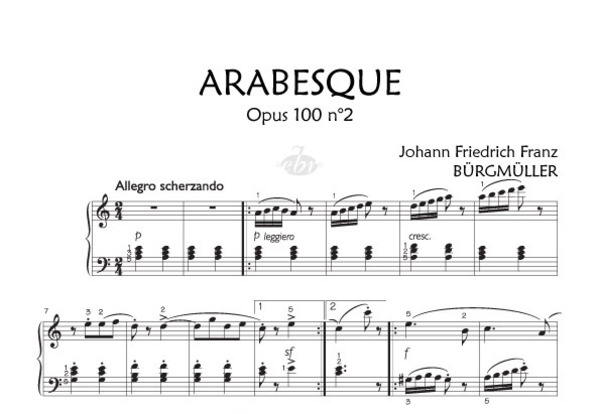
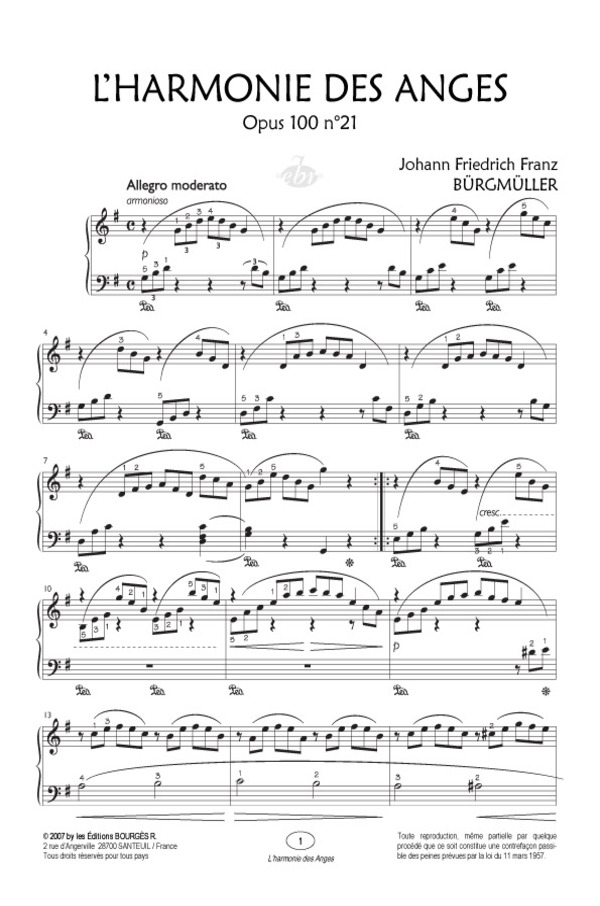
The “2 Études from Opus 100” present two contrasting faces of Romantic piano. The “Arabesque” (No. 2, in A minor) is an exercise in nervous velocity and precision; the challenge lies in the clarity of the semiquaver groups and the liveliness of the attack. By contrast, “Harmony of the Angels” (No. 21, in G major) focuses on chordal playing and on broken arpeggios shared between the two hands. For this second piece, the pianist must seek a celestial sonority and perfect fluidity in the succession of harmonies, requiring subtle use of the pedal.
Friedrich Burgmüller (1806-1874), a German-born composer settled in Paris, remains famous for his pedagogical works of rare intelligence. His collection of 25 Easy and Progressive Studies (Opus 100), composed in the 1850s, is a pillar of piano teaching. Far from the technical dryness of some of his contemporaries, Burgmüller breathes a poetic intention and an evocative title into each study, allowing the student to develop musicality along with agility. These two pieces perfectly illustrate his genius for the Romantic miniature.
No. 2 “Arabesque” in A minor
No. 21 “Harmony of the Angels” in G major