

| Author(s) / Composer(s) Johann Sebastian Bach | |
| Language(s) |
French |
|---|---|
| Collection | |
| Publisher |
Editions Bourgès R. |
| Reference |
EBRA038 |
| ISBN/ISMN |
9790560151090 |
| Instrumentation |
Piano Solo |
| Binding |
Stapled |
| Delivery method |
Digital format, Paper format |
| Publication date |
2006 |
| Weight (grams) |
100 |
| Format |
22,5 x 32 |
| Number of pages |
2 |
| Reference |
E138 |
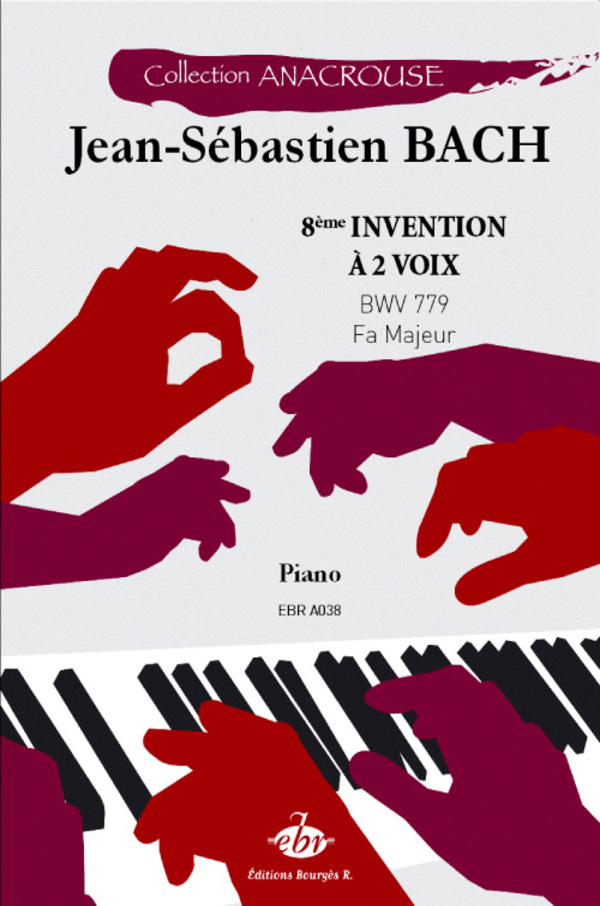
Johann Sebastian Bach
8th Two-Part Invention BWV 779The Anacrouse collection offers pianists, beginners and advanced alike, a wide choice of classical works from the Renaissance to the present day. It brings together major works of the repertoire as well as rarer pieces, and also offers transcriptions for piano solo or four hands, selected for their musical and educational interest. Each score, available individually, benefits from careful editorial work: a rigorously established musical text, clear and legible engraving, accompanied by a short biography of the composer and a note on the work.
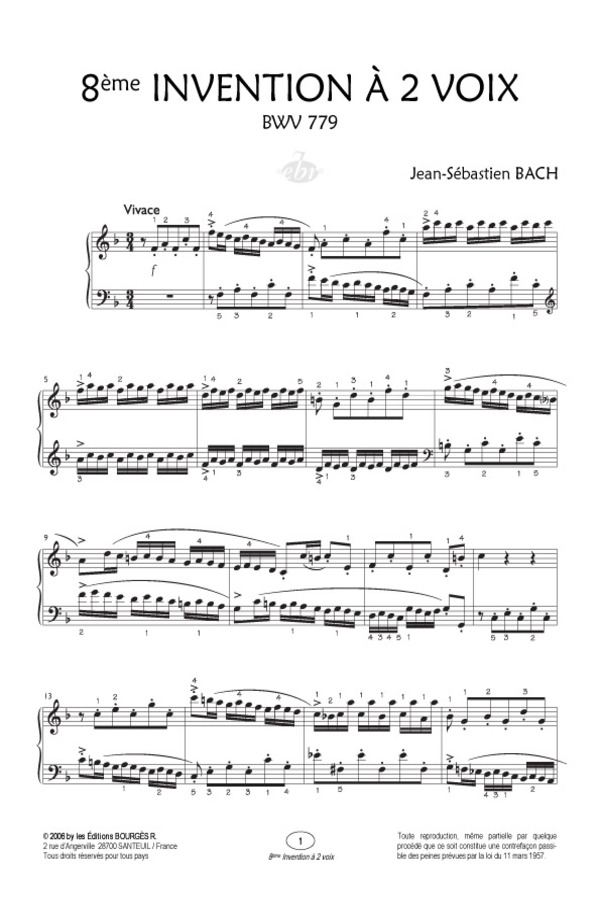
The “8th Two-Part Invention in F major, BWV 779” is a piece of overflowing vitality, often compared to a little concerto. For the pianist, it is an excellent exercise in velocity and coordination. The pedagogical challenge lies in executing the passages of broken quavers and arpeggios that pass from one hand to the other, demanding a perfectly even touch. Work on articulation is paramount here: a light, bouncing staccato on the quavers must contrast with the more sustained character of the thematic motifs, in order to preserve the full clarity of the counterpoint.
Written during the Köthen period, this invention stands out for its resolutely brilliant and playful character. Its structure rests on an almost constant canon in which the left hand faithfully imitates the right hand one bar later. Through its driving momentum and infectious joy, the 8th Invention illustrates Bach’s genius for transforming a high-level technical exercise into a page of pure music, at once learned and accessible.
8th Two-Part Invention BWV 779 in F major