


| Author(s) / Composer(s) Johann Sebastian Bach | |
| Language(s) |
French |
|---|---|
| Collection | |
| Publisher |
Editions Bourgès R. |
| Reference |
EBRA064 |
| ISBN/ISMN |
9790560151472 |
| Instrumentation |
Piano Solo |
| Binding |
Stapled |
| Delivery method |
Digital format, Paper format |
| Publication date |
2007 |
| Weight (grams) |
100 |
| Format |
22,5 x 32 |
| Number of pages |
2 |
| Reference |
E164 |
Johann Sebastian Bach
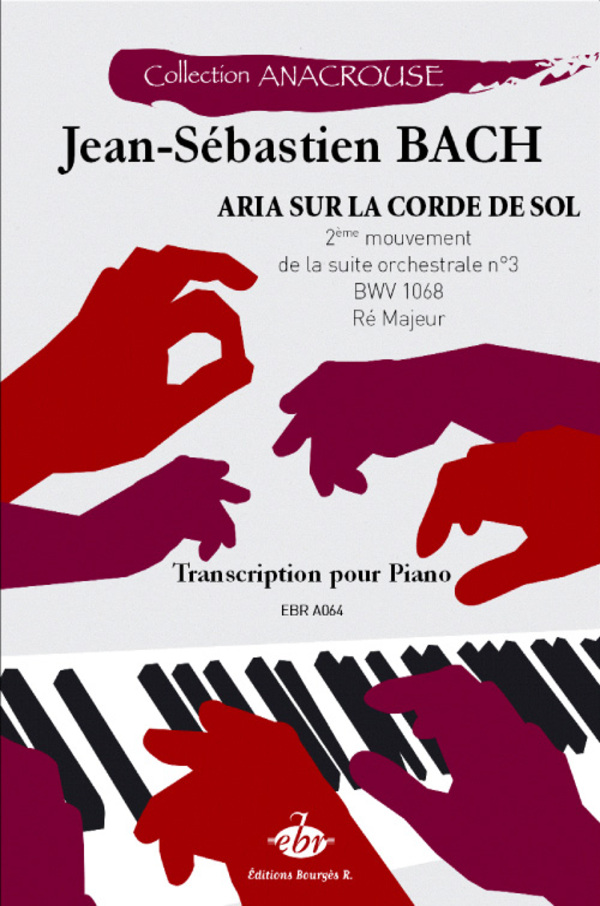
Air on the G String BWV 1068The Anacrouse collection offers pianists, beginners and advanced alike, a wide choice of classical works from the Renaissance to the present day. It brings together major works of the repertoire as well as rarer pieces, and also offers transcriptions for piano solo or four hands, selected for their musical and educational interest. Each score, available individually, benefits from careful editorial work: a rigorously established musical text, clear and legible engraving, accompanied by a short biography of the composer and a note on the work.
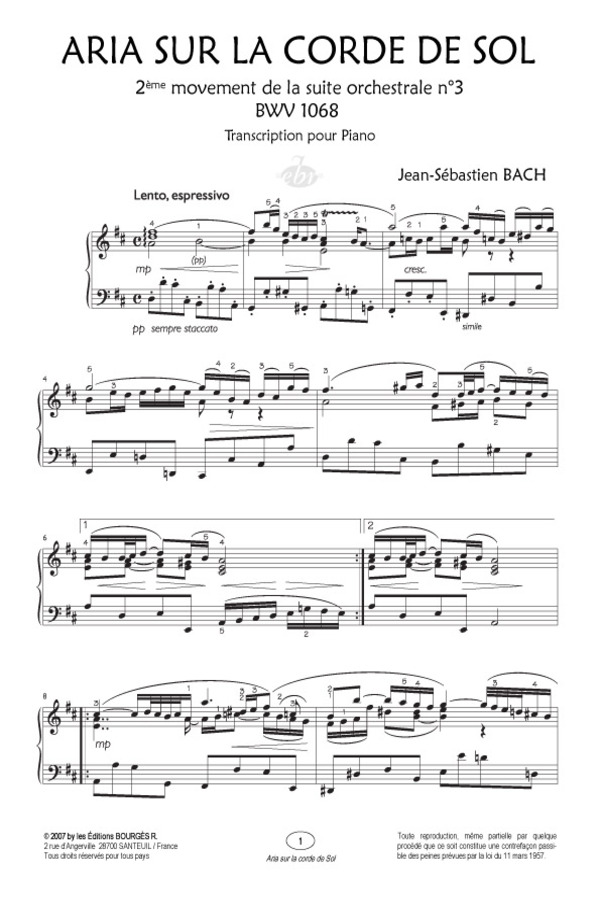
The “Air on the G String” (in D major) is a sublime exercise in legato and serenity. For the pianist, the challenge consists in separating the layers of sound: a left hand that must mark the octaves with the regularity of a pendulum (walking bass), and a right hand that unfolds an endless melody, rich in ornaments and slurs. Mastery of arm weight and shaping of the singing line are essential to avoid any break in this suspended melodic line, requiring great maturity in tone control.
Composed by Johann Sebastian Bach (1685-1750) between 1717 and 1723, this movement was originally the second part of his Orchestral Suite No. 3 in D major. Its famous title, “Air on the G String”, comes from a 19th-century arrangement by the violinist August Wilhelmj, who transposed the melody so that it could be played entirely on the violin’s fourth string. Through its formal perfection and universal character, this work has gone beyond the realm of Baroque music to become a symbol of peace and absolute fulfilment.
Air on the G String BWV 1068 in D major - 2nd movement of Orchestral Suite No. 3