



| Author(s) / Composer(s) Debussy, Claude | |
| Language(s) |
French |
|---|---|
| Collection | |
| Publisher |
Editions Bourgès R. |
| Reference |
EBRA026 |
| ISBN/ISMN |
9790560151601 |
| Instrumentation |
Piano Solo |
| Binding |
Stapled |
| Delivery method |
Digital format, Paper format |
| Publication date |
2006 |
| Weight (grams) |
100 |
| Format |
22,5 x 32 |
| Number of pages |
6 |
| Reference |
E126 |
Debussy, Claude
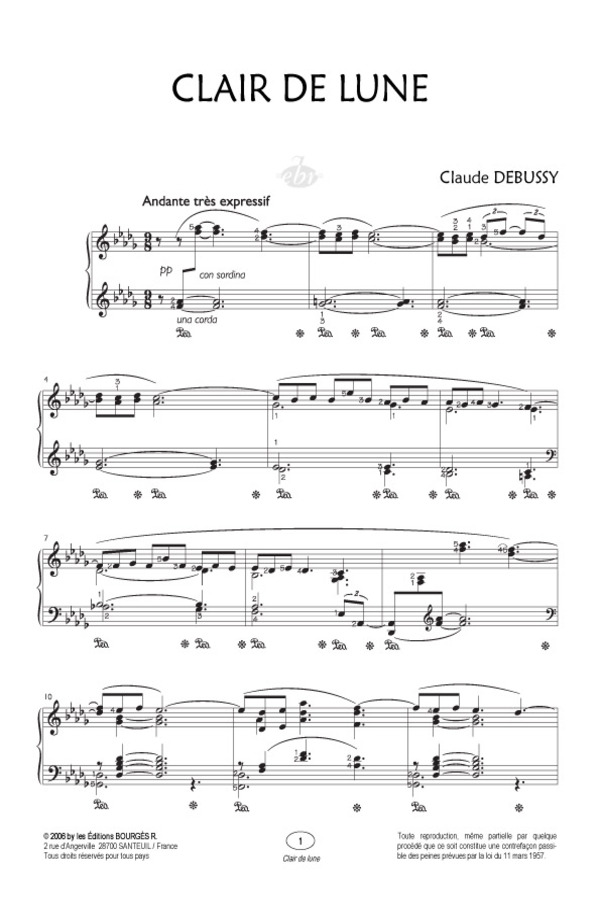
Clair de LuneThe Anacrouse collection offers pianists, beginners and advanced alike, a wide choice of classical works from the Renaissance to the present day. It brings together major works of the repertoire as well as rarer pieces, and also offers transcriptions for piano solo or four hands, selected for their musical and educational interest. Each score, available individually, benefits from careful editorial work: a rigorously established musical text, clear and legible engraving, accompanied by a short biography of the composer and a note on the work.
“Clair de lune” in D flat major, the third movement of the Suite bergamasque, is without doubt the most emblematic piece of musical Impressionism. For the pianist, this work is a masterly study in sonority and colour. It demands great mastery of playing “into the keys”, subtle use of the sustain pedal and precise handling of the sound planes to let the melody emerge amid the shifting harmonies. It is an excellent resource for working on 9/8 rhythm and the suppleness of rubato.
Composed around 1890 and revised before its publication in 1905, this piece is inspired by Paul Verlaine’s poem of the same name. Debussy abandons classical rigour for a hazy, poetic atmosphere, evoking the reflections and shadows of a nocturnal landscape. Although very famous, the work retains all its modernity through its bold harmonic language and freedom of form, establishing itself as a must of the French piano literature.
Clair de Lune in D flat major