


| Author(s) / Composer(s) Johann Strauss Jr | |
| Contributeur(s) Piano 4 Hands transcription: Jean-François Pailler | |
| Language(s) |
French |
|---|---|
| Collection | |
| Publisher |
Editions Bourgès R. |
| Reference |
EBRA077 |
| ISBN/ISMN |
9790560151632 |
| Instrumentation |
Piano 4 Hands |
| Binding |
Stapled |
| Delivery method |
Digital format, Paper format |
| Publication date |
2008 |
| Weight (grams) |
100 |
| Format |
22,5 x 32 |
| Number of pages |
16 |
| Reference |
E177 |
Johann Strauss Jr
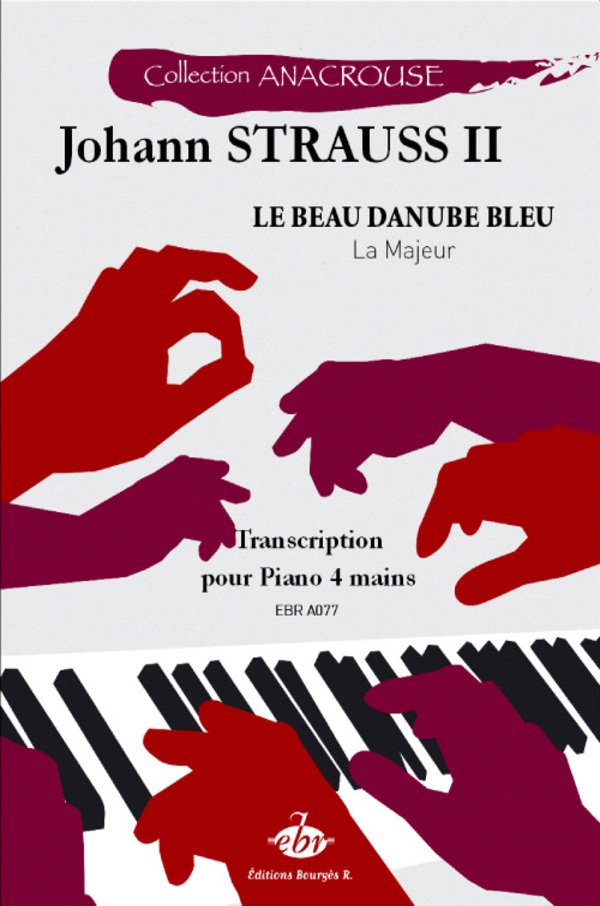
The Blue DanubeThe Anacrouse collection offers pianists, beginners and advanced alike, a wide choice of classical works from the Renaissance to the present day. It brings together major works of the repertoire as well as rarer pieces, and also offers transcriptions for piano solo or four hands, selected for their musical and educational interest. Each score, available individually, benefits from careful editorial work: a rigorously established musical text, clear and legible engraving, accompanied by a short biography of the composer and a note on the work.
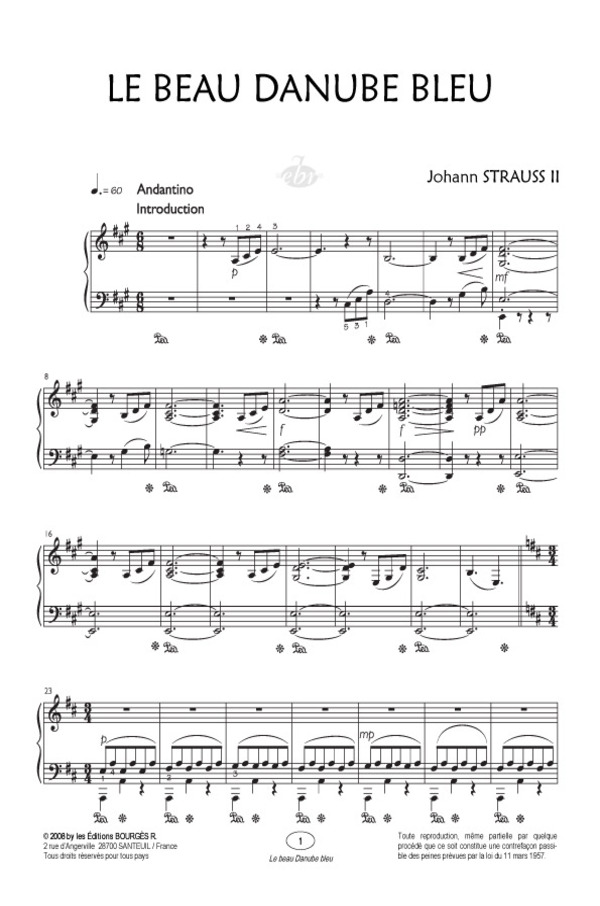
“The Blue Danube” (in A major), presented here in a piano four-hands transcription by Jean-François Pailler, is an ideal study in triple-time sway and Viennese phrasing. This title is taken from the reference songbook “8 Famous Classical Themes for Piano 4 Hands”, the first volume of the Anacrouse collection, which offers an interactive approach thanks to its 2 included CDs. For each work, three tracks are available: a reference version (Piano 4 hands), a track for practising the Piano 1 part (Piano 2 accompaniment alone) and a track for Piano 2 (Piano 1 accompaniment alone). This system allows the student to perfect rhythmic placement and synchronisation, even when practising alone.
Composed in 1866 by Johann Strauss II (1825-1899), this waltz is without doubt the most famous in the world, to the point of having become Austria’s second national anthem. The challenge for the two pianists lies in the elegance of the waltz rhythm: the Secondo must provide a supple, stable foundation (the famous “oom-pah-pah”), while the Primo unfolds the melody with all the refinement and dynamic nuances needed to evoke the glitter of the Viennese salons.
The Blue Danube in A major