

| Author(s) / Composer(s) George Frideric Handel | |
| Language(s) |
French |
|---|---|
| Collection | |
| Publisher |
Editions Bourgès R. |
| Reference |
EBRA010 |
| ISBN/ISMN |
9790560150604 |
| Instrumentation |
Piano Solo |
| Binding |
Stapled |
| Delivery method |
Digital format, Paper format |
| Publication date |
2005 |
| Weight (grams) |
100 |
| Format |
22,5 x 32 |
| Number of pages |
2 |
| Reference |
E110 |
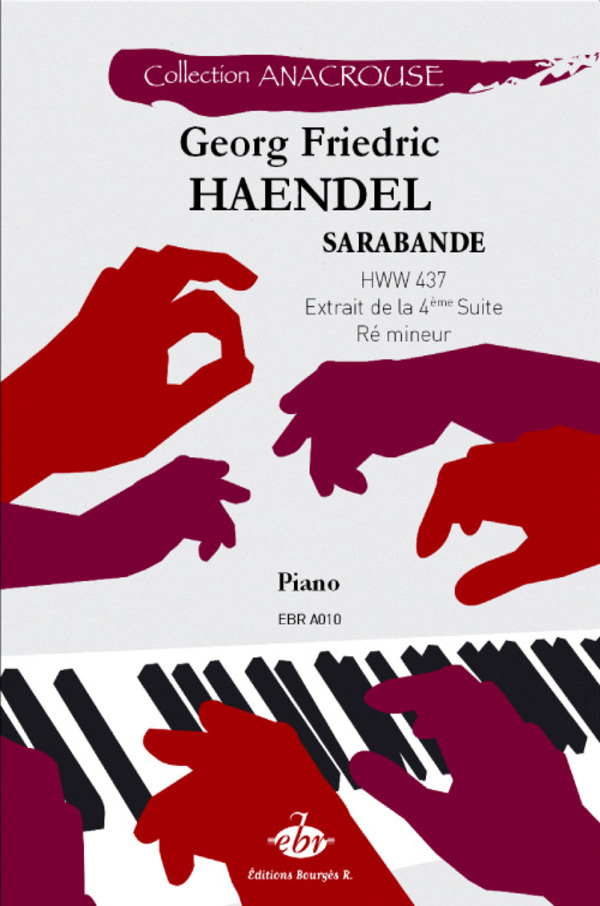
George Frideric Handel
Sarabande HWV 437The Anacrouse collection offers pianists, beginners and advanced alike, a wide choice of classical works from the Renaissance to the present day. It brings together major works of the repertoire as well as rarer pieces, and also offers transcriptions for piano solo or four hands, selected for their musical and educational interest. Each score, available individually, benefits from careful editorial work: a rigorously established musical text, clear and legible engraving, accompanied by a short biography of the composer and a note on the work.
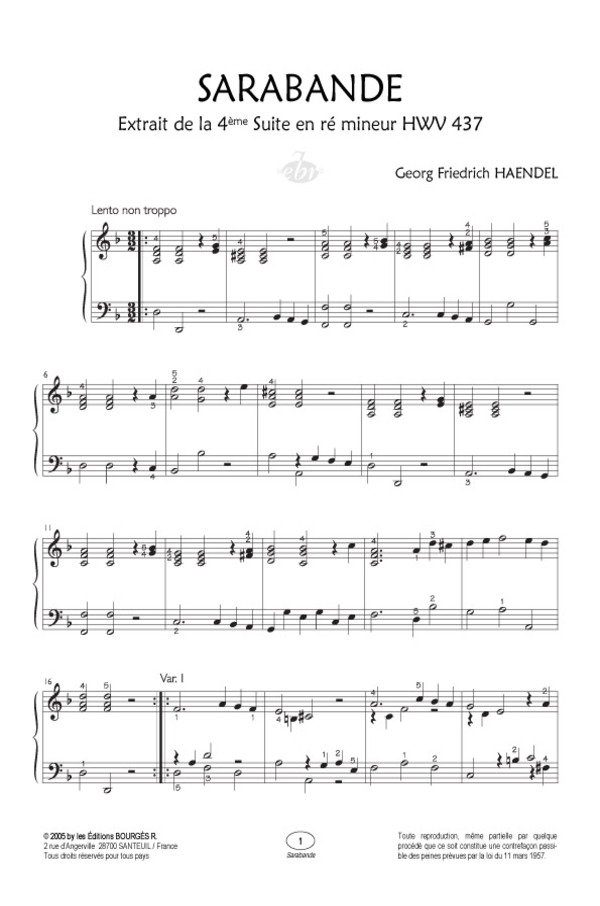
The “Sarabande in D minor, HWV 437”, taken from the Harpsichord Suite No. 4, is one of the most solemn and imposing pages of the Baroque repertoire. For the pianist, it is a masterly study in chordal playing, the management of arm weight and the mastery of progressive dynamics. Its simple structure, based on a noble theme followed by its variations, makes it possible to approach the notion of theme and variations with clarity while developing a deep, well-timbred sonority.
Composed by George Frideric Handel around 1705, this dance of Spanish origin, initially judged too lascivious by the Inquisition, found here its noblest, most hieratic form. Its immense popularity was reinforced in modern times by its emblematic use in cinema, notably in Stanley Kubrick’s film Barry Lyndon, where it powerfully underscores tragedy and fate.
Sarabande HWV 437 in D minor - From the 4th Suite