


| Author(s) / Composer(s) Wolfgang Amadeus Mozart | |
| Language(s) |
French |
|---|---|
| Collection | |
| Publisher |
Editions Bourgès R. |
| Reference |
EBRA081 |
| ISBN/ISMN |
9790560151687 |
| Instrumentation |
Piano Solo |
| Binding |
Stapled |
| Delivery method |
Digital format, Paper format |
| Publication date |
2008 |
| Weight (grams) |
100 |
| Format |
22,5 x 32 |
| Number of pages |
4 |
| Reference |
E181 |
Wolfgang Amadeus Mozart
Symphony No. 40 K. 550The Anacrouse collection offers pianists, beginners and advanced alike, a wide choice of classical works from the Renaissance to the present day. It brings together major works of the repertoire as well as rarer pieces, and also offers transcriptions for piano solo or four hands, selected for their musical and educational interest. Each score, available individually, benefits from careful editorial work: a rigorously established musical text, clear and legible engraving, accompanied by a short biography of the composer and a note on the work.
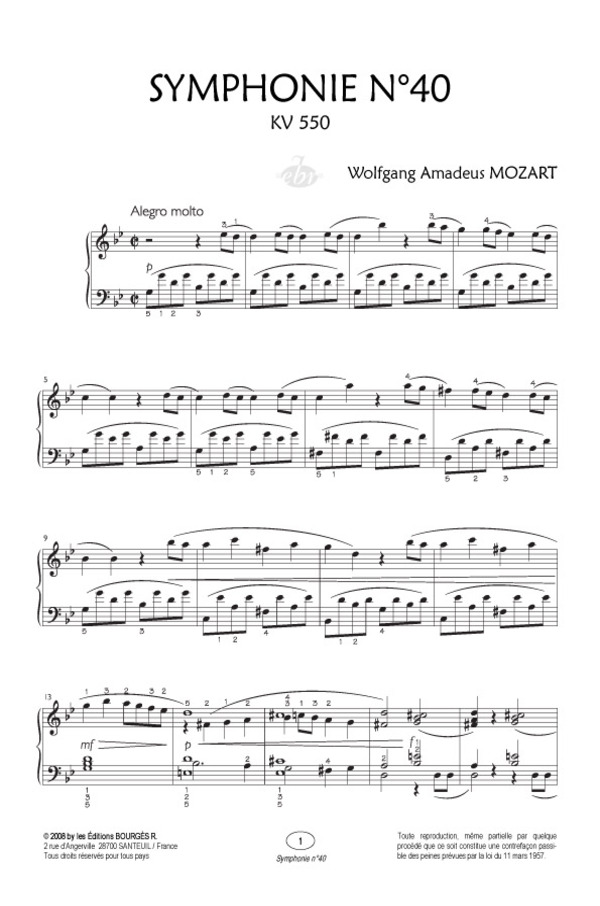
The transcription of the first movement of the “Symphony No. 40” (in G minor) is a challenge of sonic spacing for the piano. The task for the performer is to convey the feverish agitation of the strings — that famous three-note upbeat motif — while preserving the clarity of the counterpoint. The technical work bears on wrist stamina for the octaves and tremolos, as well as on finger independence to bring out the wind lines within the piano texture. It is a thrilling exercise for mastering contrasts of register and the pulsing energy specific to the symphonic style.
Composed during the summer of 1788, Symphony No. 40 (K. 550) belongs to the final cycle of three great symphonies by Mozart (1756-1791), written in just a few weeks. Unlike the majestic Jupiter, the Fortieth stands out for its tragic urgency and its pre-Romantic use of G minor. Often described as the “G minor Symphony” par excellence, it is one of the composer’s rare symphonic works not to use trumpets or timpani in its original version, thus reinforcing its intimate, nervous and dark character that has fascinated generations of musicians.
Symphony No. 40 K. 550 in G minor