
| Author(s) / Composer(s) Johann Strauss Jr | |
| Contributeur(s) Piano Solo transcription: David Neyrolles | |
| Language(s) |
French |
|---|---|
| Collection | |
| Publisher |
Editions Bourgès R. |
| Reference |
EBRA102 |
| ISBN/ISMN |
9790560153803 |
| Instrumentation |
Piano Solo |
| Binding |
Stapled |
| Delivery method |
Digital format, Paper format |
| Publication date |
2010 |
| Weight (grams) |
100 |
| Format |
22,5 x 32 |
| Number of pages |
5 |
| Reference |
E202 |
Johann Strauss Jr
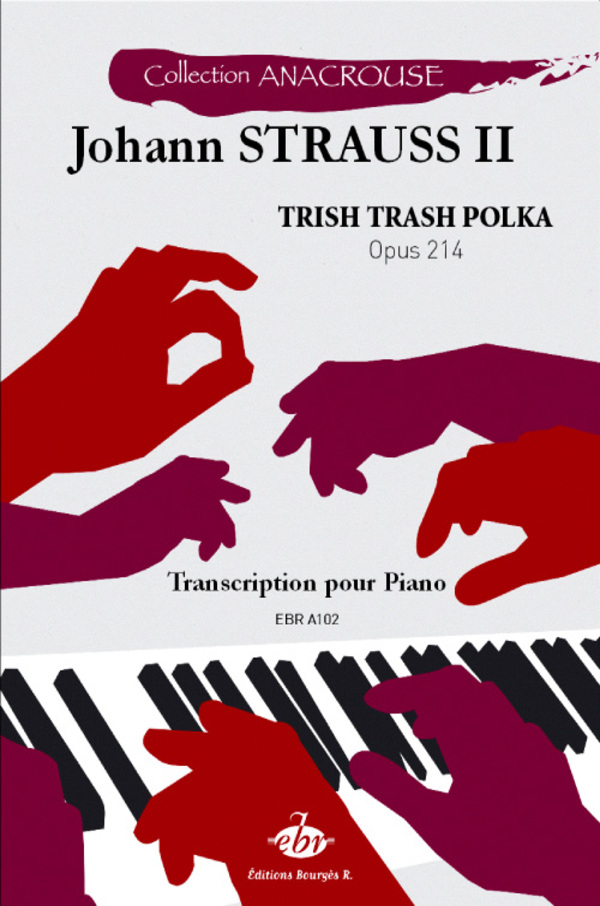
Tritsch-Tratsch Polka Opus 214The Anacrouse collection offers pianists, beginners and advanced alike, a wide choice of classical works from the Renaissance to the present day. It brings together major works of the repertoire as well as rarer pieces, and also offers transcriptions for piano solo or four hands, selected for their musical and educational interest. Each score, available individually, benefits from careful editorial work: a rigorously established musical text, clear and legible engraving, accompanied by a short biography of the composer and a note on the work.
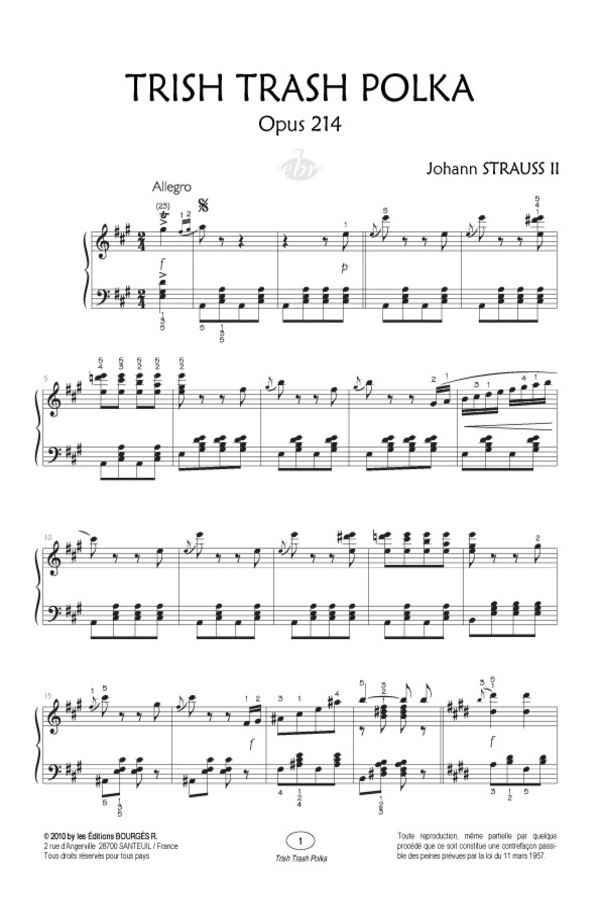
The “Tritsch-Tratsch-Polka” (Opus 214), presented here in a solo piano transcription by David Neyrolles, is a piece full of verve that demands great quickness of mind and constant rhythmic precision. This title is taken from the reference songbook “9 Famous Classical Themes for Piano”, the second volume of the Anacrouse collection. This elementary-to-intermediate transcription makes it possible to approach Viennese gaiety with fluid writing, working on bounce of touch and clarity of articulation to convey the humour and drive of this dance.
Composed in 1858 by Johann Strauss II (1825-1899), this fast polka takes its name from the title of a humorous magazine of the time evoking the “tittle-tattle” of Viennese society. A true demonstration of brio and optimism, it has become a pillar of New Year’s concerts. This edition allows the pianist to rediscover at the keyboard all the fire, brilliance and irresistible good humour of this emblematic page, whose mischievous melody stays in the ear from the very first hearing.
Tritsch-Tratsch Polka Opus 214