

| Author(s) / Composer(s) Pyotr Ilyich Tchaikovsky | |
| Language(s) |
French |
|---|---|
| Collection | |
| Publisher |
Editions Bourgès R. |
| Reference |
EBRA070 |
| ISBN/ISMN |
9790560151441 |
| Instrumentation |
Piano Solo |
| Binding |
Stapled |
| Delivery method |
Digital format, Paper format |
| Publication date |
2007 |
| Weight (grams) |
100 |
| Format |
22,5 x 32 |
| Number of pages |
3 |
| Reference |
E170 |
Pyotr Ilyich Tchaikovsky
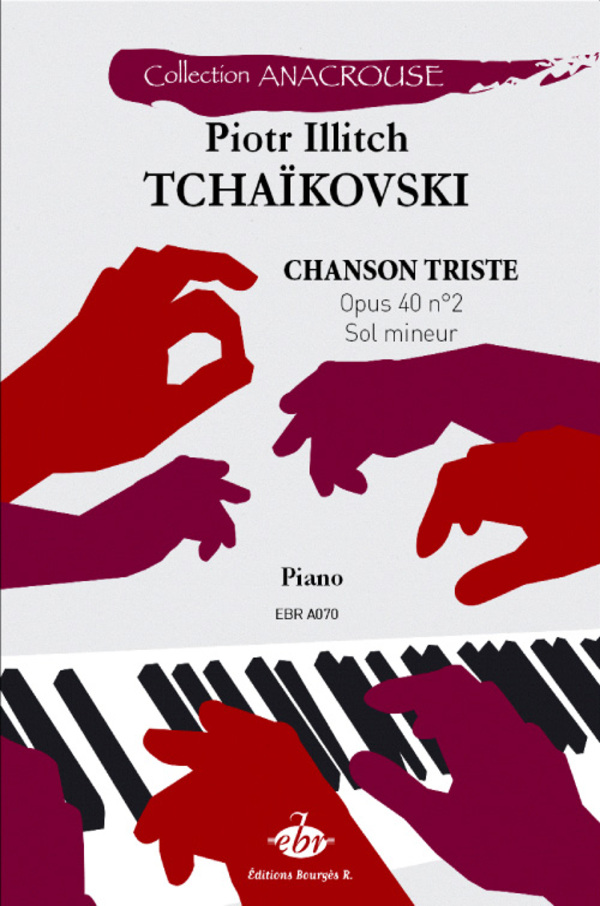
Chanson Triste Opus 40 No. 2The Anacrouse collection offers pianists, beginners and advanced alike, a wide choice of classical works from the Renaissance to the present day. It brings together major works of the repertoire as well as rarer pieces, and also offers transcriptions for piano solo or four hands, selected for their musical and educational interest. Each score, available individually, benefits from careful editorial work: a rigorously established musical text, clear and legible engraving, accompanied by a short biography of the composer and a note on the work.
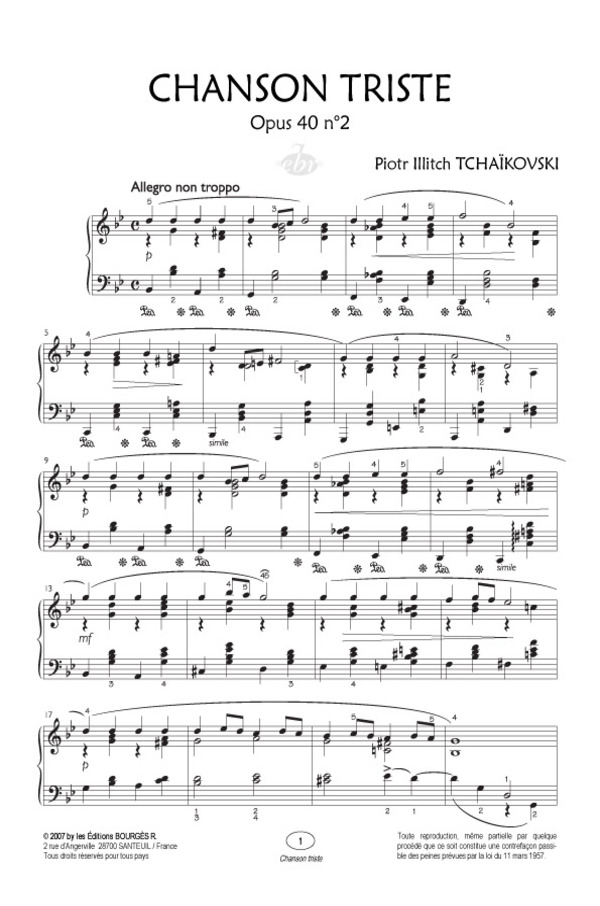
The “Chanson triste” (in G minor) is a character piece that rests on the quality of the singing line. For the pianist, the major challenge is to obtain a right-hand sonority that imitates the human voice or the cello, with a deep, expressive legato. The left-hand accompaniment, though simple in appearance, requires great suppleness to support the melody without weighing it down. Work on dynamics and the slight contrasts of the central section develops the ability to tell a story through the keyboard, between nostalgia and resignation.
Composed in 1878, this piece is part of the collection of Twelve Pieces of Moderate Difficulty (Opus 40) by Pyotr Ilyich Tchaikovsky (1840-1893). Written at a pivotal period of his life, it condenses into a few pages all the melodic genius of the Russian composer. Having become one of his most popular piano pages, it has been the subject of many arrangements (notably for violin or orchestra), but its original piano version retains a purity and poignant intimacy, reminding us that Tchaikovsky was, above all, the master of pure emotion.
Chanson triste Opus 40 No. 2 in G minor