

| Author(s) / Composer(s) Félix Mendelssohn | |
| Language(s) |
French |
|---|---|
| Collection | |
| Publisher |
Editions Bourgès R. |
| Reference |
EBRA075 |
| ISBN/ISMN |
9790560151571 |
| Instrumentation |
Piano Solo |
| Binding |
Stapled |
| Delivery method |
Digital format, Paper format |
| Publication date |
2007 |
| Weight (grams) |
100 |
| Format |
22,5 x 32 |
| Number of pages |
7 |
| Reference |
E175 |
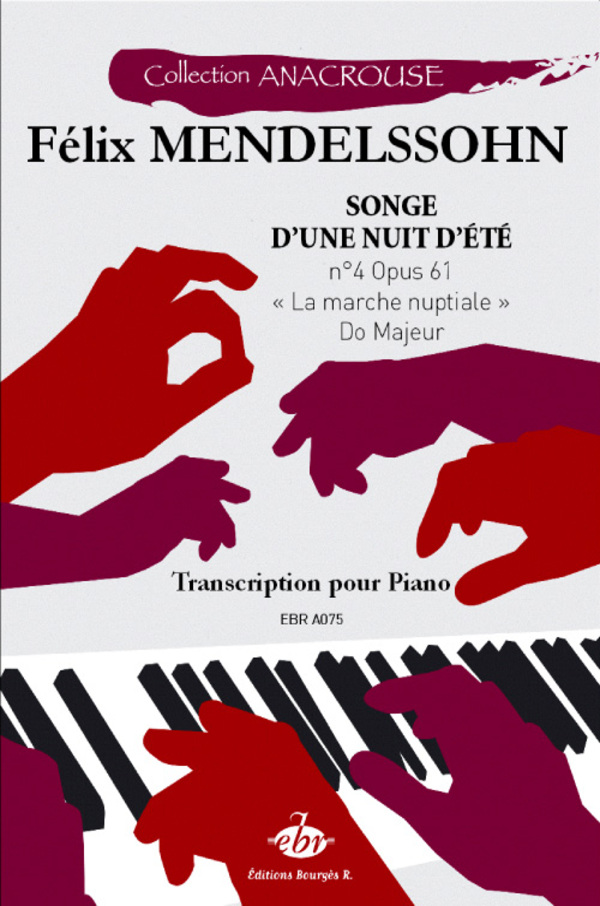
Félix Mendelssohn
A Midsummer Night’s Dream No. 4 Opus 61The Anacrouse collection offers pianists, beginners and advanced alike, a wide choice of classical works from the Renaissance to the present day. It brings together major works of the repertoire as well as rarer pieces, and also offers transcriptions for piano solo or four hands, selected for their musical and educational interest. Each score, available individually, benefits from careful editorial work: a rigorously established musical text, clear and legible engraving, accompanied by a short biography of the composer and a note on the work.
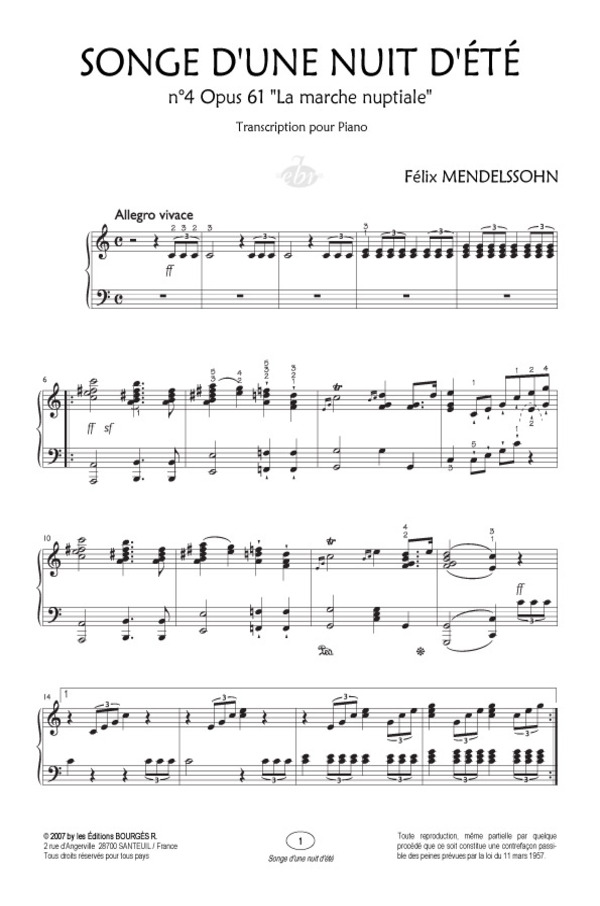
The “Wedding March” (in C major) is a ceremonial piece that demands great mastery of chords and rhythmic framework. For the pianist, the technical work bears on the power of the attack — which must remain noble and never harsh — and on the precision of the dotted notes that give the march its heroic character. The challenge lies in the management of sonic space: the block chords must sound with the fullness of an organ or an orchestra, while the intermediate episodes call for a lighter touch.
Composed in 1842 by Felix Mendelssohn (1809-1847), this march is the fourth number of the incidental music for William Shakespeare’s “A Midsummer Night’s Dream”. While the work was premiered at the Prussian court, it was its use at the wedding of Princess Victoria of Great Britain in 1858 that propelled it to the rank of universal wedding anthem. A masterpiece of the Romantic era, this piece perfectly illustrates Mendelssohn’s genius for reconciling classical clarity and lyrical impetus, making every performance a moment of absolute solemnity.
A Midsummer Night's Dream No. 4 Opus 61 in C major - “Wedding March”